Turf Repair and Seam Fixes Overview
Turf repair across The Woodlands and the north Houston corridor is a more nuanced service than it appears from the outside. The community's forest canopy creates specific failure patterns in existing synthetic turf installations that are different from what happens on sun-exposed properties in other parts of the Houston metro. Root heaving under installations that were not planned around tree root protection zones, seam failures caused by seasonal ground movement under heavy clay subgrade, and edge migration along transitions that were not adequately anchored against the wet-dry soil cycle that characterizes Montgomery County soils — these are the repair triggers we see most frequently in this market.
Artificial Grass of The Woodlands approaches repair work diagnostically. A lifted seam is a symptom of something — an inadequate anchor at installation, a base that shifted, a drainage problem that saturated the subgrade, or a root system that grew into the base and displaced it. Addressing the seam without identifying and correcting the root cause means the same failure returns within months. We diagnose before we repair, and we scope the corrective work to address what actually failed rather than just what is visibly wrong.
The Woodlands market has a substantial inventory of existing synthetic turf installations — properties that installed turf ten years ago when the first generation of residential synthetic products was being placed across the community, and commercial properties that installed turf during the period of rapid Town Center and ExxonMobil campus development. Many of those installations are reaching the end of their original seam and anchor system life, and the combination of north Houston's heavy rainfall and the clay soil movement cycle is accelerating the timeline on repairs. We work on those existing installations with the same planning discipline we bring to new work.
Repairs also arise from installation-specific issues: seaming products that were not appropriate for The Woodlands climate, infill systems that have compacted to the point of no longer supporting the pile, and edge anchoring that was under-specified for the soil conditions of a particular site. We document our findings during the repair assessment so the homeowner or facility manager understands what was wrong, what we corrected, and what to watch for going forward.
What Is Included in Turf Repair and Seam Fixes
Every repair engagement starts with a diagnostic assessment. The scope below describes the core repair components, which are combined based on what each site-specific failure requires.
- Diagnostic Site Assessment - Evaluate the failure pattern, identify whether the root cause is at the seam, the base, the drainage system, or the edge anchor, and document findings before recommending repair scope.
- Root Cause Analysis Documentation - Provide a written or verbal summary of what caused the failure so the homeowner or facility manager understands the repair and can make informed decisions about future maintenance.
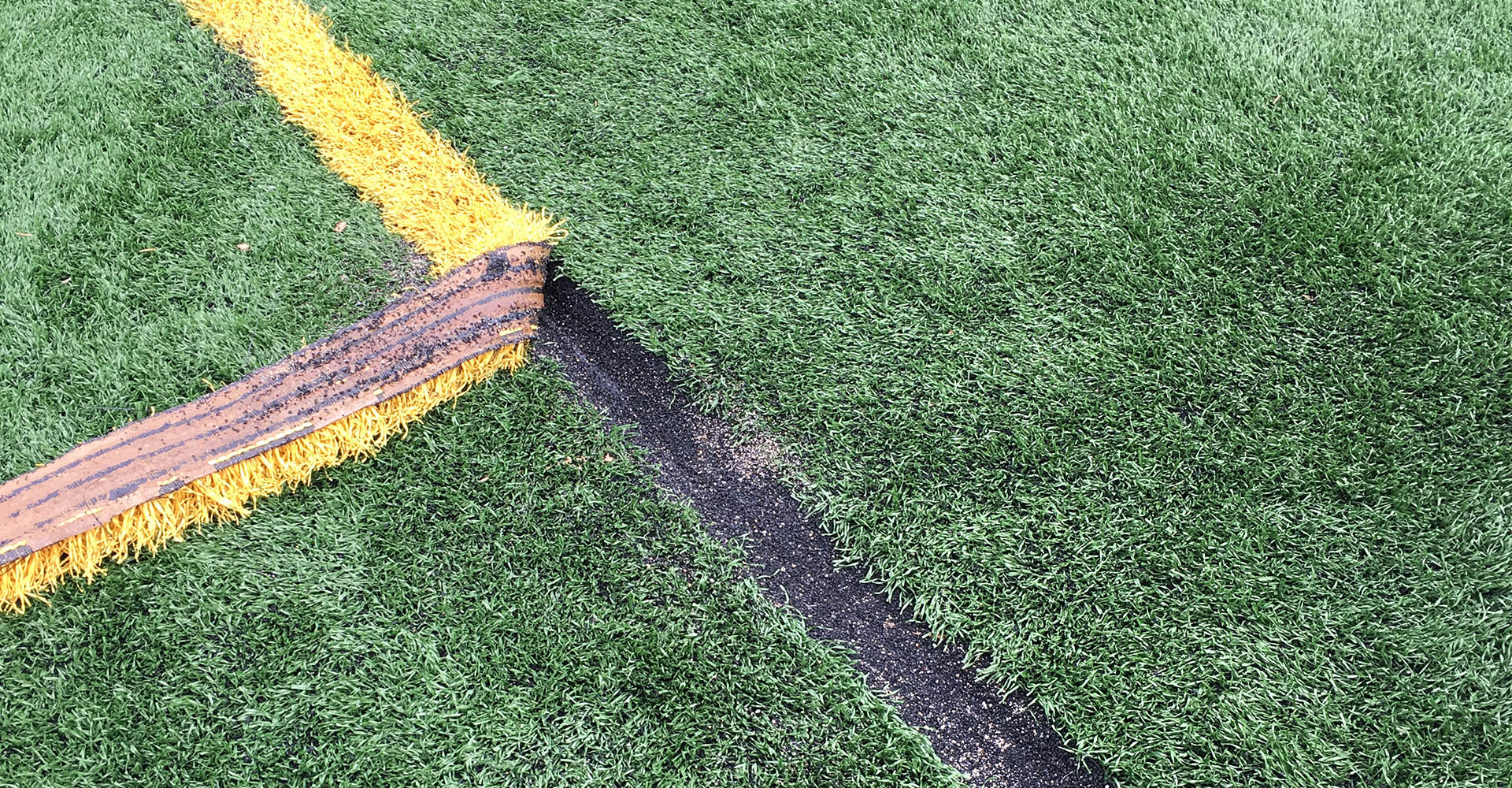
- Seam Reopening and Re-bonding - Open failed seams properly, clean bonding surfaces, and re-seam with appropriate adhesive for the substrate and climate conditions.
- Base Correction Under Affected Area - Where base migration, root intrusion, or drainage saturation caused the surface failure, correct the subgrade condition before reattaching the turf layer.
- Edge and Perimeter Re-anchoring - Lift migrated edges, address the anchor failure, and re-secure perimeter turf to prevent continued edge movement.
- Wrinkle and Deformation Correction - Release and re-stretch turf panels where thermal cycling or base movement created wrinkles or surface deformation affecting appearance and safety.
- Infill Level Assessment and Adjustment - Evaluate infill levels in the repaired area and adjoining zones, and top-dress where compaction or loss has reduced pile support below functional levels.
Process Steps for Turf Repair and Seam Fixes
Repair work follows a diagnostic-first sequence that keeps the corrective scope aligned with the actual failure rather than just the visible symptom.
1. Assessment and Root Cause Identification
We evaluate the failed area, probe the base, check drainage function, and identify whether the failure is at the seam bond, the base, the anchor system, or a combination of these.
2. Repair Scope Confirmation
Based on the assessment, we confirm with the property owner what corrective work is needed, what the expected outcome is, and whether any underlying conditions require ongoing monitoring after repair.
3. Access and Material Preparation
Failed seams are carefully opened without damaging adjacent sections, base issues are accessed, and repair materials appropriate to the original installation type are prepared.
4. Corrective Work Execution
Base corrections, seam re-bonding, edge re-anchoring, and surface adjustments are completed in sequence so each step supports the next without creating new stress points.
5. Surface Inspection and Care Guidance
The repaired area is inspected against the surrounding surface for visual and functional consistency. We review what to monitor going forward and what maintenance adjustments might extend the corrected installation life.
Repair Applications Across The Woodlands and North Corridor
Repair requests in The Woodlands and surrounding communities follow predictable patterns related to the community's soil conditions, canopy environment, and the age profile of existing installations.
Root-Heaved Base Repairs in Canopy Zones
Properties where existing turf was installed over or adjacent to loblolly pine or hardwood root systems without adequate clearance develop base deformation as roots continue growing into the aggregate. These require base correction that respects the tree while stabilizing the surface.
Clay Soil Movement Seam Failures
The clay-dominant soils across much of Montgomery County and the Conroe-area communities experience significant seasonal expansion and contraction. Seams in installations over these soils that were not adequately engineered for that movement develop predictable failure patterns that we address at the bond level and the base level.
Aged Residential Installation Repairs
The Woodlands has a significant population of synthetic turf installations from the early and mid-adoption period that are reaching seam and anchor system end-of-life. These typically need seam rebonding, edge re-anchoring, and infill top-dressing without full replacement.
Storm Damage Correction
Hurricane remnants and severe thunderstorm events occasionally cause edge lifting, surface displacement, and drainage system disruption that require corrective repair on both residential and commercial installations.
Why Property Owners in The Woodlands Choose Artificial Grass of The Woodlands for Repairs
Property owners choose Artificial Grass of The Woodlands for repair work because we understand the specific failure mechanisms that affect synthetic turf in this community. Root heave, clay soil movement, pine needle accumulation in infill, and the heavy rainfall drainage demands of north Houston are not generic problems — they are specific to this environment. We diagnose to that level of specificity and repair accordingly, rather than applying a one-size corrective approach that leaves the underlying cause unaddressed.
Pricing Factors for Turf Repair and Seam Fixes
Repair costs vary significantly based on what caused the failure and how much of the existing installation needs to be accessed or corrected to fix it properly.
Failure Scope and Surface Area Affected
A single seam failure in a low-use area costs significantly less to address than widespread edge migration or multiple seam failures across a large installation.
Root Cause Severity
Failures caused by base migration, root intrusion, or drainage system problems require more corrective work than surface-level seam or edge failures where the subgrade is intact.
Compatibility with Existing Installation
Repairs to older installations sometimes require sourcing materials that match the existing turf profile, which can affect material cost and lead time.
Access Constraints
Repairs in areas with limited access from root systems, adjacent structures, or active landscaping take more time than repairs in open, accessible locations.
Base Correction Requirements
When the base must be accessed and corrected beneath the turf, the scope expands beyond surface-level repair to include aggregate, compaction, and drainage work.
Infill Assessment and Top-Dressing
Installations with significantly depleted infill levels in the repair zone or adjacent areas require infill addition as part of the repair to restore pile support to the correct depth.
Service Area Coverage
We provide turf repair and seam fixes across The Woodlands, TX, including Spring, Shenandoah, Conroe, Tomball, Magnolia, Oak Ridge North, Porter, Humble, Cypress, Montgomery, Willis, Pinehurst, Cut and Shoot, and Jersey Village.
Related Services
Turf Drainage and Base Corrections
Drainage-focused remediation for puddling, runoff pressure, base instability, and surface pooling problems.
Learn More
Turf Cleaning and Maintenance
Scheduled turf cleaning, decompaction, grooming, and seasonal maintenance for long-term performance.
Learn More
Residential Artificial Turf Installation
Durable landscape turf systems for front yards, backyards, pool zones, and everyday family use.
Learn More
Commercial Artificial Turf Installation
Synthetic turf planning and installation for office, retail, and multi-site commercial properties.
Learn MoreFrequently Asked Questions About Turf Repair and Seam Fixes
Can a lifted seam be fixed without replacing the entire turf section?
In most cases, yes. If the turf material itself is not damaged and the base beneath the seam is intact, the seam can be re-opened, cleaned, and re-bonded. If the base shifted or a root system grew into it, we address that condition before re-bonding so the repair holds.
How do tree roots cause synthetic turf to fail?
Tree roots growing into the compacted aggregate base can displace the base material, creating lumps and surface deformation. If the original installation did not leave adequate clearance from root zones, this is a predictable long-term outcome in a tree-dense community like The Woodlands.
My turf is developing wrinkles but was installed less than three years ago. What causes this?
Wrinkles in relatively new installations are usually caused by insufficient panel tension at installation, base material that settled more than anticipated, or thermal expansion causing the turf to buckle in areas where it was not adequately anchored. We can diagnose the specific cause during a site visit.
Can you match the existing turf profile when repairing or patching?
We work to source materials that closely match the existing installation. For older installations, exact matching is not always possible because product lines change over time. We discuss available options during the assessment so you can make an informed decision.
What causes turf edges to migrate away from concrete or other hard surfaces?
Edge migration along concrete transitions is usually caused by anchor system failure combined with soil movement. The wet-dry clay cycle in Montgomery County soils creates significant seasonal pressure on edge anchors. Re-anchoring with a method appropriate to the soil conditions is the corrective approach.
Is it worth repairing an older installation or should it be replaced?
The answer depends on the overall condition of the installation, how many failures are present, and whether the failures are isolated or symptomatic of system-wide issues. We give an honest assessment during the site visit that includes the economics of repair versus replacement based on the specific installation's condition.